Energy (兵势) names one job here: Spend fewer — 少耗. Use momentum to shorten conflict. Ordinary force is enough when timing and coordination line up. You do not need more destruction.
Sun Tzu: in all fighting, the direct method may be used for joining battle, but indirect methods will be needed in order to secure victory. Indirect tactics, efficiently applied, are inexhaustible as Heaven and Earth. The regular side holds what must hold. The unexpected move ends the cycle sooner. Unexpected is not theatrical. Unexpected is the shorter path. Shorter paths spend fewer people.
The onset of troops is like the rush of a torrent which will even roll stones along in its course. The quality of decision is like the well-timed swoop of a falcon. Energy is direction after conditions stack. It is not charging because the mood arrived. Write separately: is the moment now, or only the feeling.
This page is not a growth post about manufacturing hype to crush a rival. The English H1 is Spend fewer. The Chinese is 少耗. Read the chapter after this note.
What 兵势 actually asks
Managing many is like managing few — it is a question of organization. Fighting with many is like fighting with few — it is a matter of signals. That the whole army may withstand the enemy without defeat depends on 奇正. That your impact may be like a grindstone dashed against an egg depends on emptiness and solidity. Organization, signals, regular and unexpected, empty and solid: all are combinations. Demanding perfection from every person is not energy. Energy is ordinary people in the right place at the right time.
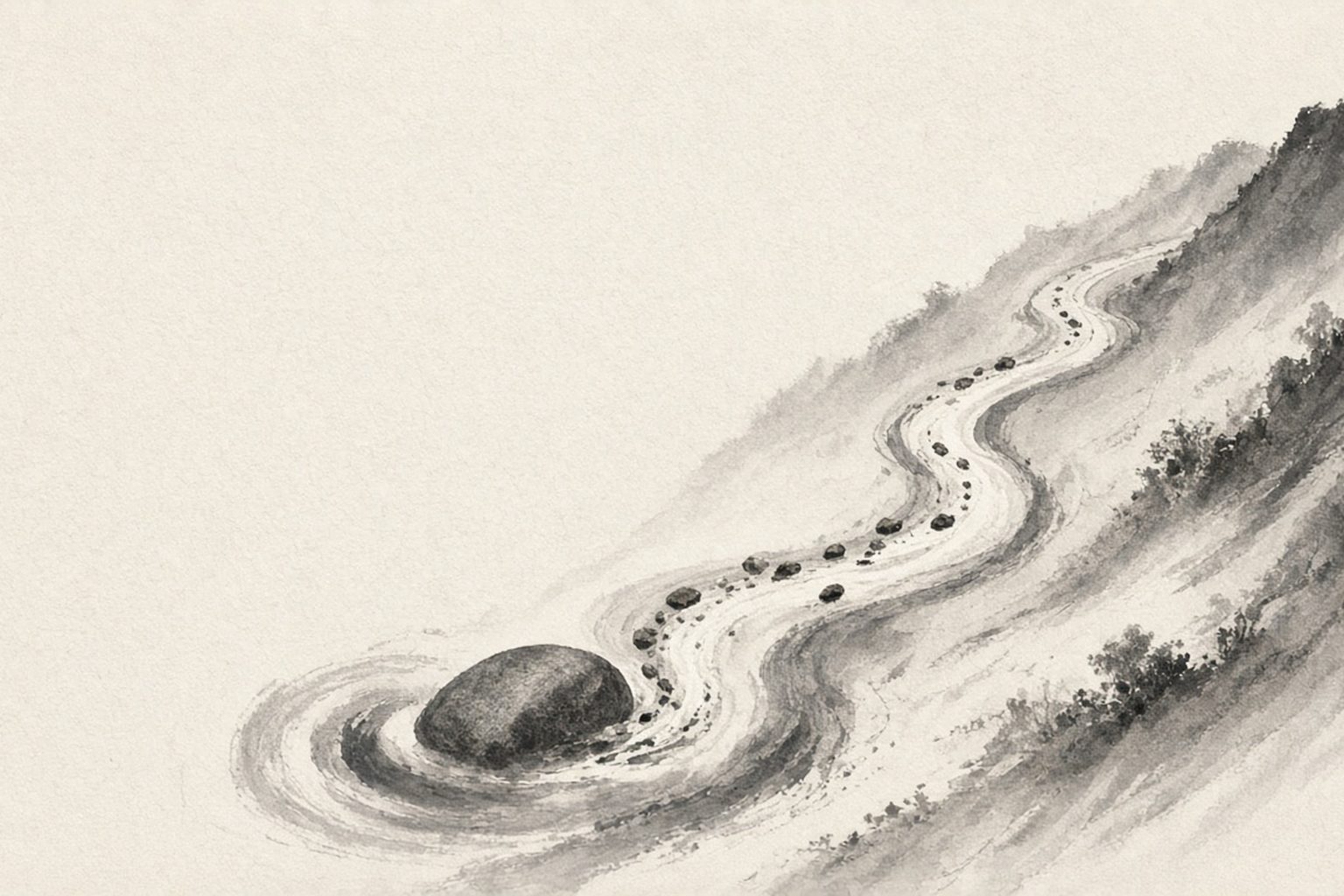
The energy developed by good fighting people is as the momentum of a round stone rolled down a mountain thousands of feet in height. The stone is not a crueler weapon. It is gravity already ready, so a light touch is enough. Adding destruction usually means energy never formed, so people fill the gap.
On sun-tzu.ai, 兵势 follows 军形: shape holds, then momentum. Momentum must point toward less waste. If the combination points toward escalation, it is not energy; it is upgrade. Upgrade belongs back in 作战 with a stop date.
Four checks
- Object: the work already moving or about to move.
- Regular: what must hold and not scatter.
- Unexpected: which one move ends the conflict sooner.
- Timing: now, or only mood.
- Judgment: does the combination point to spending fewer. If it points to more force, stop, change the combination, or write a stop date.
If you cannot write “spend fewer” on the combination, do not go unexpected. Unexpected that adds people is a losing energy.
Spending fewer is not stinginess. It is duty to people nearby: one less night, one less well opened twice, one less letter that only lengthens the thread.
What “energy sun tzu” wants in search
Queries like energy sun tzu, 兵势, and 奇正 want how to use momentum to spend less money and fewer people. This site does not read energy as vibe or pep talk. Energy is a checkable combination and moment.
Teaching puts regular and unexpected on one sheet. Contact is for class and content, not for manufacturing pressure.
兵势 is fifth because after shape, the dearest error is more destruction in place of a better combination. Kindness nearby and under heaven is one move: use momentum to spend fewer.
Momentum is not a pep talk
Reading Energy as hype is the usual error. Momentum is direction after organisation, signals, and regular/unexpected are already in place. Talk momentum before people are organised, and you will fill gaps with overtime. Overtime returns you to the daily burn in Waging War.
Fight with the regular; win with the unexpected. If the regular side collapses, the unexpected is only noise. If the unexpected does not shorten the conflict, it is not unexpected — it is extra theatre. Theatre points toward escalation, not toward spending fewer. Spending fewer must be writable: fewer people, fewer hours, fewer letters that only lengthen the thread.
A cadence of two or three SEO notes a week must also obey spend-fewer: not padding word count, but aiming each note at one searchable judgment. This note aims at energy / spend fewer. Publish it, then send readers back to the chapter with internal links — not toward a revenue-war script.
Search and the teaching funnel
Queries for energy sun tzu and 奇正 are takeable compared with the encyclopedia head term. Rank for the job Spend fewer. Link to Energy, to Tactical Dispositions for shape, to Weak Points and Strong for empty place, to Waging War for the stop date, and to contact only for teaching. That is the leizi idea of feeding the pages that matter — adapted from product pages to judgment pages.
One combination in practice
Write the regular hold. Write the unexpected shorten. Write whether the moment is now. If the three lines do not add up to fewer people and fewer hours, do not release the stone. A stone rolled without gravity ready is just a rock you have to carry back up the hill — that carry is the daily burn again.
When this note is live, pair it in the blog index with Hard to defeat and Empty place so the week reads as one arc: shape, momentum, emptiness — still without restoring a business-war voice.
Close
Kindness under heaven, in this chapter, is refusing to buy a shorter path with more destruction. Spend fewer is the whole score. Teaching stays teaching. The chapter evidence stays under the judgment. Publish, link, and stop.
If you only remember one line from Energy, remember this: ordinary force is enough when the combination is ready. Extra destruction is usually a confession that the combination was never ready. Write the combination. Check the hour. Spend fewer. Then go back to the chapter and keep the classical text as evidence, not as decoration. That is enough for one publish cycle. Stop when the next cycle is already lighter. Fewer fights. Fewer people spent. Better next cycle.